

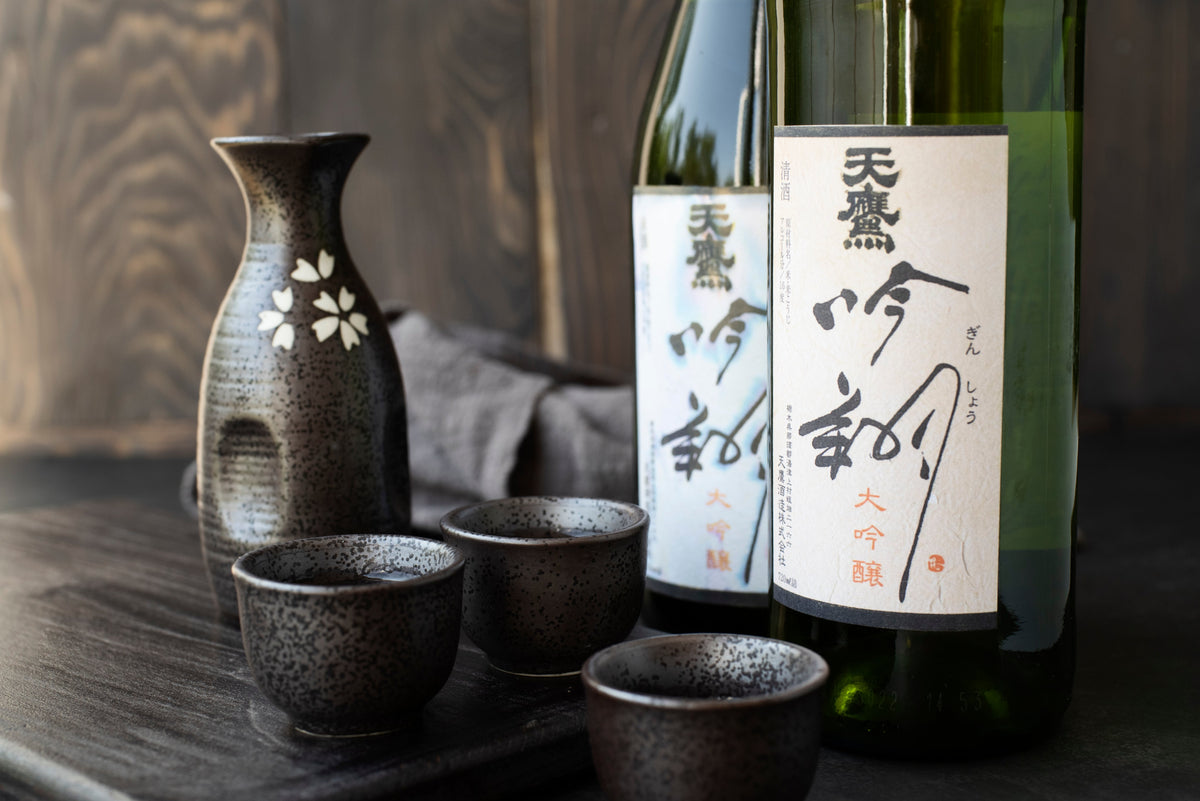
Anyone standing in front of a well-stocked sake shelf for the first time will see the same words again and again: Junmai, Ginjo, Daiginjo, and sometimes Honjozo. They sound like flavor profiles or quality seals. Neither is entirely accurate.
In fact, these terms describe only two things: how much the rice has been polished and whether distilled alcohol has been added. Once you understand these two axes, you can read any label — even one that is entirely in Japanese.
Axis 1: The Degree of Polishing
A rice grain is not the same throughout. Proteins, fats, and minerals are located on the outside; the core consists of almost pure starch. During brewing, proteins and fats provide bold, earthy, and sometimes bitter flavors. The starch in the core provides the delicate, floral, and fruity notes.
This is why sake rice is polished before brewing. The Seimaibuai — the degree of polishing — indicates how much of the grain is left. This is the most common confusion of all:
- Seimaibuai 70% means: 30% was polished away, 70% remained.
- Seimaibuai 50% means: half the grain is gone.
- Seimaibuai 35% means: almost two-thirds of the grain was processed into flour.
The lower the number, the more laborious — and the more expensive. At 35%, a brewery needs about three kilos of raw rice for one kilo of brewing rice. The rest does not disappear: the rice flour from the polishing process is used for items such as rice crackers, baked goods, and sweets, while the outer bran (nuka) is used for pickling vegetables or as animal feed.
Axis 2: With or Without Added Alcohol
The second question is simpler. Junmai (純米, "pure rice") means: only rice, water, koji, and yeast. Nothing else.
If the word Junmai is missing, a small amount of distilled alcohol has been added — usually just before pressing. For the Honjozo, Ginjo, and Daiginjo categories, the amount is strictly limited: no more than 10% of the rice weight, calculated as pure alcohol at 95% vol. This is not a filler and not a sign of poor quality, even if it has been described that way for a long time. Alcohol dissolves certain aromatic compounds better than water, and a small addition extracts the exact volatile, floral notes from the mash that would otherwise remain in the lees. The result is often clearer and more fragrant, not weaker.
Rule of thumb: Junmai tends to taste fuller, rounder, and more like rice. Non-Junmai tends to taste clearer, lighter, and more aromatic. Both can be excellent.
The Two Axes Combined
Combine both, and the categories explain themselves:
- Honjozo — at least 30% polished away, with added alcohol. The classic everyday sake. Handles warmth well.
- Junmai — no fixed minimum polishing rate, no added alcohol. Bold, savory, often the best companion for food.
- Ginjo — at least 40% polished away, with added alcohol. Cool, slow fermentation. Distinctly floral.
- Junmai Ginjo — the same, but without the addition. Slightly more body, slightly less perfume.
- Daiginjo — at least 50% polished away, with added alcohol. The flagship category for many breweries.
- Junmai Daiginjo — at least 50% polished away, without the addition. Usually the most expensive shelf.
What the Category Does Not Reveal
And now the most important part: the category says nothing about whether you will like the bottle.
A Junmai Daiginjo is technically more complex to produce and significantly more expensive than a simple Junmai. That does not automatically make it the better companion for your dinner — on the contrary. Highly polished sakes are often delicate and reserved; they simply disappear next to a strongly spiced dish. The cheaper, more robust Junmai stands its ground.
Three pieces of information on the back label tell you more about the taste than the category:
- Nihonshudo (Sake Meter Value) — roughly the sweetness-dryness axis. Negative values are sweeter, positive values are drier.
- Sando — the acidity level. Higher acidity creates more structure and makes it more food-friendly.
- The Yeast — Kyokai numbers like 1801 or 9 indicate very fruity profiles reminiscent of melon and pear.
A Practical Introduction
If you want to taste the categories rather than just read about them, buy three small bottles: a Honjozo, a Junmai, and a Junmai Ginjo. Chill all three to about 12°C and taste them in that order, a few milliliters each, using a white wine glass instead of a traditional cup — the glass concentrates the aromas significantly better.
You will notice the difference immediately, not as "better" or "worse," but as three distinct characters. From then on, the label is no longer a riddle, but a map.
Tokubetsu — The Exception to the Rule
Occasionally, the word Tokubetsu (特別, "special") appears: Tokubetsu Junmai, Tokubetsu Honjozo. It means that the brewery has done something that goes beyond the requirements of the category — more intensive polishing, a highly prized rice variety like Yamada Nishiki, or a more complex fermentation process.
The prerequisite is clearly regulated: the rice must be polished to at most 60%, or the brewery must use a special production method. According to Japanese labeling rules, the brewery must explain exactly what is special using objective information on the bottle or packaging, such as the polishing rate, rice variety, or the process used. A look at the back label is therefore worthwhile: that is where it states what the "special" aspect is. Because the reasoning can be chosen freely, Tokubetsu remains the most diverse term in the system.
The Terms That Truly Alter the Taste
Now for the part that most introductions omit. In addition to the category, other words often appear on the label, and these often change the character more than the polishing rate:
- Namazake (生酒) — unpasteurized. Regular sake is heated twice; Nama is not at all. The result is fresh, zesty, often slightly sparkling, with a vibrant fruitiness that pasteurized sake never has. It must be kept refrigerated at all times and should be consumed within a few months.
- Genshu (原酒) — undiluted. Sake comes out of the press at around 18–20% vol and is normally diluted down to 15–16%. Genshu skips this: denser, stronger, warmer in the finish. Excellent over a large ice cube.
- Muroka (無濾過) — literally "unfiltered." In practice, this usually means forgoing charcoal filtration; after pressing, the sake is at most coarsely clarified. Charcoal filtration makes sake clearer and smoother, but it also strips away character. Muroka retains its color (often a slight yellow or gold tint) and rough edges.
- Nigori (濁り) — coarsely filtered, cloudy. Creamy, seemingly sweeter, very good with spicy food.
- Koshu (古酒) — aged. Stored for years, amber-colored, with notes of caramel, soy sauce, and dried fruit. A world of its own, closer to sherry than what one expects from sake.
These terms can be combined. Junmai Ginjo Muroka Nama Genshu is not marketing fluff, but a precise description: pure rice, at least 40% polished away, no charcoal filtration, unpasteurized, undiluted. Anyone who can read these five words knows quite accurately what to expect.
Temperature — The Underestimated Lever
One final point that is not on any label and yet determines the evening. Sake is one of the few beverages that is seriously served over a range of about 50 degrees, and the same bottle can taste like two different products at 8°C and at 45°C.
- 5–10°C (yuki-hie to hana-hie). For Ginjo, Daiginjo, Nama, and Sparkling. Cold preserves the volatile aromas.
- 15–20°C (suzu-hie to hiya). The range in which most good Junmai show their peak. Cellar temperature, not refrigerator.
- 40–45°C (nuru-kan to jō-kan). For Junmai and Honjozo with body. Warmth stretches the texture and lifts the umami notes. The traditional upper limit is tobikiri-kan at around 55°C; any hotter and the alcohol evaporates noticeably, making the sake sharp.
The rule behind this is simple: The more aromatic the sake, the colder it should be served. The more robust, the warmer. Warming up a Junmai Daiginjo is a waste of money — you drive away exactly what you paid for. Serving a good Junmai ice-cold is the same mistake in the other direction.


